End of the Silk Road: Sogdian Ancient letters
By Ben Stacey
Edited by Annabel Wearring-Smith and Will Dawson
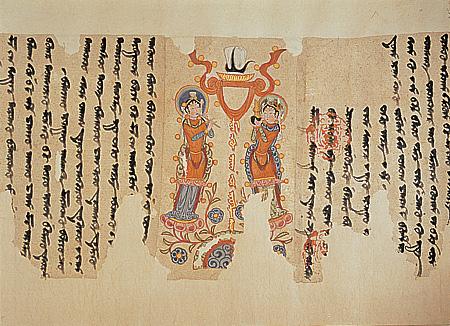
If you walk 90 miles west of Dunhuang, into the depths of the Gobi Desert, you will find a watchtower. A sand-scarred remnant of the great Jade Gate. A desolate place. The end of the Silk Road, if you will.
In 1907, the intrepid explorer and cartographer Sir Aurel Stein came across this tower. Upon exploring the ruins, he discovered a cache of five letters in an unknown script. They were impeccably preserved; sheltered from the elements and kept dry by the arid climate of the Gobi. Thankfully, Stein had the foresight to preserve these letters.
The letters were written on papyrus by the Sogdians: an ancient Iranian people hailing from present-day Uzbekistan and Tajikistan. Their homeland, Sogdiana, was located in the heart of the Silk Road, allowing them to prosper as merchants. In fact, the Sogdian language in which the letters are written was the lingua franca of the Silk Road. Long forgotten to time, Stein’s discovery shed light on the influence and importance of the Sogdians on this ancient trade route.
The letters show a telling picture of an expatriate merchant culture in Western China, along with all the trappings of travelling to far-flung lands in search of profit. Journey into a world of profit, danger and intrigue as I explore the Sogdian Ancient Letters. Look through the heated haze of sand and see our first traveller approach:
“I was warned that it is dangerous to wander in China”
Frikhutav is an experienced merchant, buying and selling pepper and rice, and transporting staters of silver. He finds himself 3800km from his home in Samarkand, stranded in Guzang. His associate has disappeared over the mountains into a sea of sand. The only thing to do is to send word along the Silk Road and petition his master in Sogdiana for support.
“The Sogdians who are in Dunhuang are in great need. I myself depend on the mercy of your Aprak.”
With his cargo on hold and his associates disappearing, Frikhutav sits worried on the edge of the world. His compatriots are destitute and struggling, yet Frikhutav still chases down profit. He complains of underweight silver and unpaid debts. News from inside China gets worse and worse.
While Frikhutav contemplates, others are set into action:
“The last emperor, they say, fled from Luoyang because of the famine, and fire was set to his palace and to the city. Luoyang is no more, Ye is no more!”
Nanai-vandak writes to his partners in Samarkand, wrapping his letter in brown silk and an outer layer of tough fabric, complete with instructions for delivery. He sends word from a war-torn China: the Xiongnu (or Huns) have sacked the Chinese capital of Luoyang and run rampant across the country. The Chinese chronicles date these shocking events to 307-311 AD. Stein’s discovery of this preserved letter provides us with firsthand insight of the events.
“As for us, those, who are in the land from Jincheng to Dunxuang, we are barely alive. We both are without families, are both old and are on the fringe of death. If it were not like this, I would not have been ready to write you about how we are doing. And, o Masters, if I were to write you about everything that has happened now with China, it would have been beyond all grief.”
Admist all this chaos, Nanai-vandak finds himself on the precipice. Without the security of the state and monarchy, the Sogdians are exposed; their position as travelling merchants is precarious as they become just more nameless faces, lost to famine and pillage. These letters, sent in near desperation, immortalise them for future generations. Without written correspondence, one wonders how much more knowledge would be lost to the sands of time.
A new character emerges from the fragments:
“I send you letters again and again, but I do not receive a single letter from you, and I lost all hope of seeing you. And in such a trouble I have lived in Dunhuang, because of you.”
Minway (literally meaning tiger cub) is the wife of the merchant Nanai-dhat, who has abandoned her and her daughter in Dunhuang. Ignoring the advice of her family, she follows her husband to the end of the Silk Road. He disappears without a trace, leaving his wife and daughter destitute and alone. Trapped by the chaos of China and the forces of patriarchy, Minway petitions and begs her associates to take her to her mother or her husband.
“I should have better become the wife of a dog or a pig than your wife”
Trapped and under pressure from the Chinese, ‘tiger cub’ bares her teeth and roars obscenities at her husband. She seems desperate and confused, three years without correspondence, just a steady, unrelenting silence. I find myself musing about Nanai-dhat’s location. Was he cut down by the scythe of a pillaging Hun? Did he find himself staring down at a bloated stomach in the heat of famine? Perhaps he took off with another woman. Perhaps it is true what they say, that hell hath no fury like a woman scorned. We will never know. Our journey with the Sogdian’s has ended.
The letters of these roving merchants, spurned wives and expatriates paint a picture of chaos and order, showing us the sensibilities and values of a remarkable people stuck on the edge of the known world. The Sogdian correspondence shows us the intricacies of life that are found in ancient letters, and the range of human emotions they capture. This insight into individuals who would have been long forgotten is priceless, and only found in the intimacy of handwritten letters.
If you are interested in the Sogdians and want to know more about them and their correspondence visit the Smithsonian Institution’s Online exhibit here
The Letters Page team are back in the office, and ready to read your real letters again. We publish stories, essays, poems, memoir, reportage, criticism, recipes, travelogue, and any hybrid forms, so long as they come to us in the form of a letter. We are looking for writers of all nationalities and ages, both established and emerging.
Your letter must be sent in the post, to :
The Letters Page, School of English, University of Nottingham, NG7 2RD, UK.
See our submissions page for more information.
To stay up to date on The Letters Page newsletter publication, subscribe here.
 theletters.page