Artistamps: A Forgotten Art Form?
By Amy Plant
Edited by Naomi Adam & Maria Rocha
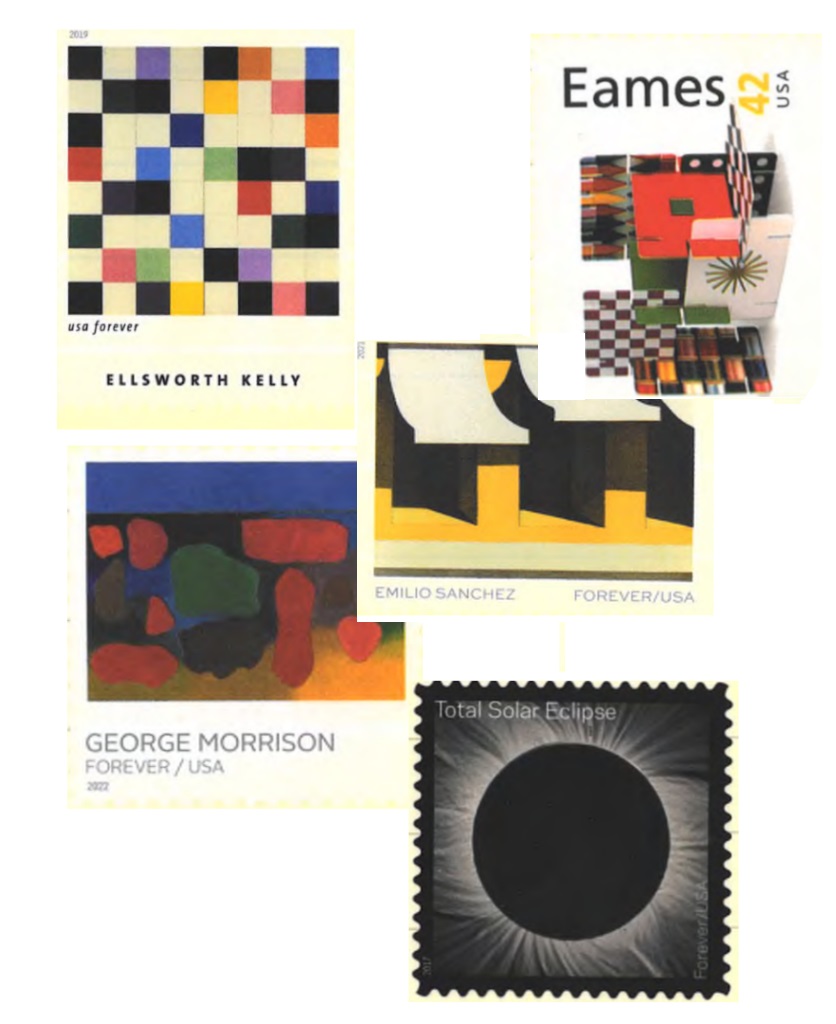
The one-of-a-kind letter featured in our latest aerogramme comes from Nay Saysourinho. This letter immediately stood out to us because it featured five unique stamps. They were all commemorative stamps, with four displaying art from prominent artists, and one commemorating the 2017 total solar eclipse visible in North America. At first glance, these stamps seemed unrelated. But when viewed as a sequence in the order they were pasted on the letter, instead of individually, they could be read as a visual story.
The bright colours of Ellsworth Kelly’s art and the playfulness of the Eames’ stamp are followed by the muted palette of the George Morrison stamp and the diminishing light of Emilio Sanchez’s ‘Shadows’. Darkness seeps into the sequence, culminating in the final stamp – the total solar eclipse, the absence of all light. The sequence begins with blocks of colour and ends with total darkness.

Of course, this is only one possible interpretation of a visual story the stamps may be telling. They could simply be five stamps that Nay liked. But something about the order feels purposeful. Nay also directly references colour and light in her written captions next to the stamp, writing of moving from the ‘light’ and ‘bright’ back to the ’shade’.
While Nay uses commemorative stamps in her letter, the use of stamps as a medium to tell a visual story recalls so-called Cinderella stamps or artistamps. The artistamp, as the name suggests, is an art form in which artists design their own stamps. In 1982, the Hungarian artists and founders of the Artpool Art Research Centre, György Galántai and Júlia Klaniczay, hosted the World Art Post exhibition in Budapest. People from all over the world, including the USA and the USSR, submitted stamps. Today, Artpool houses one of the largest archives of artistamps and mail art in the world.
The stamps from the project can be viewed on Artpool’s interactive website. The stamps, all submitted in black and white, were printed on sheets in various colours. The sheets don’t appear to be organised by theme, such as by the country of origin, and the pages are untitled. However, many artists who submitted multiple stamps clearly intended for them to be sequenced, perhaps to tell some sort of visual story, like the four clock designs or the polaroid-esque shots of a couple seen on the sheet below.
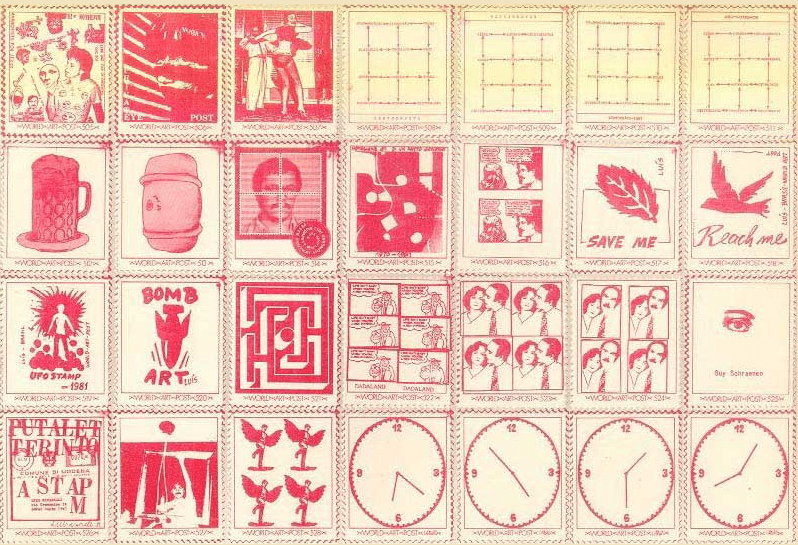
https://artpool.hu/Artistamp/WAP/wap505.html
I discovered this project while searching for examples of visual storytelling through stamps, as well as information about philately (stamp collecting) in general. The philatelic community is still very active today, with exhibitions in the UK like Stampex, and vibrant online communities like the r/philately subReddit.
Artistamps are also proudly displayed in the Museum of Artistamps, which opened in Seattle in 2012, curated by Robert Rudine, more commonly known as Dogfish. Dogfish and his wife Dragonfly (Janet Yoder) live in the self-proclaimed nation of Tui Tui in Seattle. They have produced many stamps for their houseboat island nation (which is not yet officially recognised).

The artistamp is a tool for eclectic world-building and boundless creativity, connecting people from across the world. While it may not be forgotten as an art form, it is overlooked and underappreciated. As both the artistamp and Nay’s letter make clear, if the text in a letter can tell a story, the art of its stamp can tell a story of its own.
We publish stories, essays, poems, memoir, reportage, criticism, recipes, travelogue, and any hybrid forms, so long as they come to us in the form of a letter. We are looking for writers of all nationalities and ages, both established and emerging.
Your letter must be sent in the post, to:
The Letters Page, School of English, University of Nottingham, NG7 2RD, UK
 theletters.page
One thought