‘It’s not a campaign, it’s curiosity’: A Retrospective on The Letters Page
by Arwyn Clayton, Elodie Edwards, Zoe Lidbury and Bernadette O’Hara
Edited by Naomi Adam
The Letters Page goes back to its roots this week in a retrospective on its achievements and changes over the years, in conversation with its editor, Jon McGregor.
The seed for The Letters Page was planted back in 2012 when editor Jon McGregor first began his professorship at the University of Nottingham. But something was missing… he created a small literary magazine, keen to introduce a practical element to his teaching.
What began as an unsuspecting blog page, advertising itself as ‘the letters page for a journal that doesn’t yet exist’, soon morphed into a professionally-produced journal of which every page was a letters page. For the first edition, Jon wrote to a wide range of authors – some familiar to him, some not – inviting them to contribute. When we spoke with Jon about The Letters Page’s early popularity, he mused that the promising number of responses he received were possibly because writers could pen a letter without pressure in a short coffee break, a much less intimidating or time-consuming task than the short stories or poetry requested by other journals.
Writers could pen a letter without pressure in a short coffee break, a much less intimidating or time-consuming task than the short stories or poetry requested by other journals.
Jon emphasised that the journal springs from a passionate interest in the letters’ content, rather than a desire to champion a lost artform. He is keen that the project’s purpose is not misinterpreted, affirming that ‘it’s not a campaign, it’s curiosity’. Indeed, though its audience has fluctuated in numbers, the journal continues to attract those who appreciate letters and authorship in their own right.
With the help of various teams of students from the university’s School of English, The Letters Page has experimented with various formats, from printable PDFs and emails to aerogrammes and print copies.
Three years after its inception, in November 2016, The Letters Page released its first print edition with Book Ex Machina, an independent publishing imprint based in Cyprus. A compilation of stand-out submissions from its first years, this long-awaited tangible volume offered readers a taste of the closeness that comes from handling and reading handwritten letters in a way the original PDF version couldn’t. The next three years saw three more printed volumes, each with a unique letters-based design.
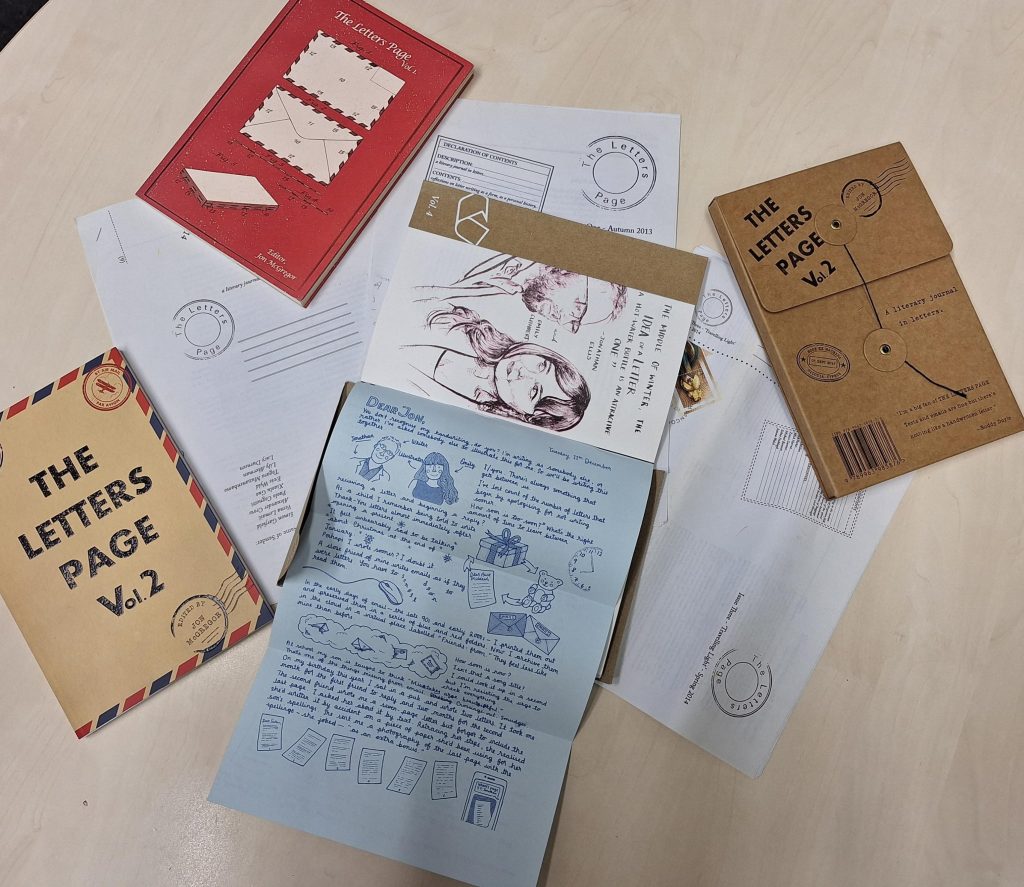
During the pandemic, The Letters Page embraced digitisation, accepting submissions by email for the first time in its history. This blurring of the boundaries between digital and written communication opened up a whole new world to the journal, demonstrating, in Jon McGregor’s words, that ‘one’s not better, they’re just different’.
In recent years, The Letters Page has been sent as an aerogramme to subscribers. However, it hasn’t entirely eschewed the digital world, and regular features and interviews posted on the website provide a wealth of additional reading for those interested.
Now, in collaboration with Nottingham City of Literature, The Letters Page is preparing for the print release of Volume 9, a special edition of translated letters from nine other global UNESCO Cities of Literature. Scheduled for publication in December 2025, this unique collection will include the letters in both their original language and in English, along with a short note from each translator offering a glimpse into the translation process. The Letters Page looks forward to taking readers on this fascinating journey around the world.
The Letters Page team are back in the office, and ready to read your real letters again. We publish stories, essays, poems, memoir, reportage, criticism, recipes, travelogues, and any hybrid forms, so long as they come to us in the form of a letter. We are looking for writers of all nationalities and ages, both established and emerging.
Your letter must be sent in the post, to:
The Letters Page, School of English, University of Nottingham, NG7 2RD, UK
See our submissions page for more information.
 theletters.page