In Support of Christmas Cards
By Arwyn Clayton, Elodie Edwards, and Bernadette O’Hara
Introduced by Zoe Lidbury
Edited by Zoe Lidbury & Naomi Adam
The first commercial Christmas card was commissioned by Henry Cole in 1843, a time-saving device for the busy Christmas season, when he often struggled to open – let alone answer – all his festive mail. His answer? A colourful illustration, with a clear Yuletide message, and capacity for personalisation. Very little has changed.
Today, with increased living costs and rising postal charges, and free and effortless communication via the internet, Christmas cards aren’t a priority, too-often judged ‘too expensive’. Last year, shopping trends reports revealed a 23 percent decrease in the sales of boxed cards, with individual cards (of the sort that read ‘To a Special Mum/Dad/Sister/Brother/Cat/Dog/Vaguely-defined In-law’) down 15 percent. Some people have replaced physical cards with digital e-cards, and some have abandoned the endeavour altogether.
At The Letters Page, we believe the impersonal buzz of an electronic notification shouldn’t be allowed to replace the rattle of the letterbox, followed by the satisfying thud of Christmas post on the doormat. To reflect this sentiment, below my colleagues from the web team share some festive anecdotes in support of the humble Christmas card.
– Zoe Lidbury
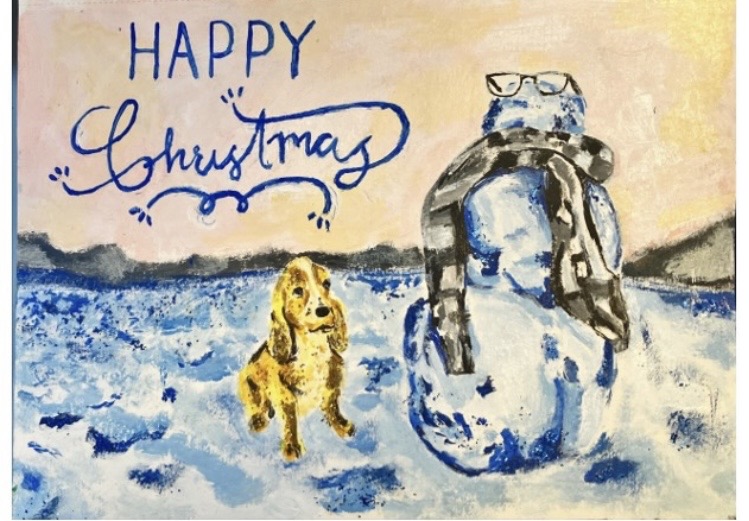
As a child, I innocently asked for art supplies from Santa one year, and lo-and-behold, a set of paints arrived dutifully in my stocking on the 25th of December. At the same time, I inadvertently branded myself the family’s resident artist. Following Christmases brought more provisions, such as watercolours and knitting kits.
Every year, I would oversee the Christmas cards – an honour not taken lightly – starting in early November. The finished results varied in quality, but whether it was a snowman, Santa, reindeer, or holly, it was made with a great deal of love and glitter.
Later, when I began to create more serious designs (and ran out of time to make everyone a card), my parents would photocopy the original scene I had painted and print this out for the family. Thus, the magic continued…
The rapid decline in the popularity of Christmas cards makes me wonder if my card will be solitary on mantlepieces this year. Even if it is just some paper and ink, its capability to spread joy surpasses anything on a computer screen – and I’ve had many reports from relatives that prove it.
From Elodie
Despite living in England, reminders of my Irish heritage were prominent in my upbringing. In December, these came in the form of Christmas cards. The excitement of receiving a Christmas card from Ireland started with the envelope.
A blue sticker stating ‘BY AIR MAIL’ was the first sign of the card’s sender. The second, and my personal favourite clue, was the stamp that displayed the Irish word ‘Eire’ (Ireland). It’s an upgraded version of recognising the handwriting on an envelope, the additional stamps indicating something special.
As well as a clue to where the contents had come from, the stamps added a special, unspoken message. They were evidence of the journey taken; despite the Irish sea in-between family members, through these cards a part of us was still able to reach one another. The Christmas cards felt warm and personalised, gentle reminders of the love that exists even in places where you’re not physically present.
This outreach at Christmas was one I always looked forward to, and is where I think my interest in handwritten letters came from, eventually leading me to The Letters Page – a full circle moment.
From Bernadette

When I think of Christmas cards, I remember the entryway of my Granny’s house in the lead up to Christmas. Walls and doors strung with cheery puns and frosty images, this gallery growing through the month as more cards dropped through the letter box. I remember being wowed (though not at all surprised) by the amount of people going out of their way to send love and joy to her at Christmas. It felt like walking into a primary school Santa’s Grotto: a familiar, usually unimpressive room converted into something magically transportative.
This adornment made the cards into more than they inherently were. Like any greeting card, they’re usually considered a momentary pleasantry, written out of obligation, then read and quickly discarded. Reconfiguration as decorations revived them; being greeted by festive well wishes from friends and family when entering the house delivered that warm feeling of comfort and contentment we all crave at Christmas.
Modern decorations are often mass-produced plastic horrors, a haphazard sprinkling of glitter their only tenuous link to the festive season. In contrast, the spirit of community and connection evoked by cards is invaluable. The excitement of receiving a card someone else has taken the time to write and send is far greater than anything sparked by a text. Furthermore, knowing that you can spread that feeling to others through something so simple as a card is, to me, a perfect encapsulation of the spirit of Christmas.
From Arwyn

Didn’t manage to send us a Christmas card? Don’t worry, we still want to hear from you! The Letters Page team are back in the office, and ready to read your real letters again. We publish stories, essays, poems, memoir, reportage, criticism, recipes, travelogues, and any hybrid forms, so long as they come to us in the form of a letter. We are looking for writers of all nationalities and ages, both established and emerging.
Your letter must be sent in the post, to:
The Letters Page, School of English, University of Nottingham, NG7 2RD, UK
See our submissions page for more information.
Need some inspiration in your letter-writing endeavours? You can purchase our latest collection, The Letters Page, Vol. 5, by clicking here.
 theletters.page