On the Same Page: A Conversation on Collaborative Writing
By Arwyn Clayton, Elodie Edwards, and Zoe Lidbury
Edited by Naomi Adam
Now many co-authored articles in, The Letters Page Web team reflects on their experiences of collaborative writing while working with the journal: the challenges, the quiet rewards, and the hot chocolates…
Throwing ourselves in at the deep end, we began this placement as web editors for the literary journal The Letters Page with a three-part retrospective series on the journal. Our original plan was to write one article between the four of us, each focusing on a section of TLP’s history and future. One small part was to be an interview with the journal’s editor-in-chief, Jon McGregor. However, as soon as we’d composed a set of questions it was clear we’d have enough answers to constitute an article of its own. Accordingly, we split our original plan into three separate pieces, each of which was written either individually or by a pair. To reinstate collaboration, we approached editing as a group, so we all had a hand in every article to some extent.
A different technique we’ve used is writing as if one. Zoe and Elodie took this approach for the article ‘Can Books Bridge Nations?’, inspired by the letter from Lviv featured in our recently published Volume 5. Trying to write with a single voice informed by multiple minds, as opposed to editorially integrating our distinct styles into a coherent whole, exposed us to a completely new creative process. When multiple writers work as one, their idiosyncrasies and unique ideas merge and mingle in ways that they otherwise could not, allowing any single sentence to become something that none of us would ever have composed alone.
In our most recent article, an anecdotal support of Christmas cards, we tried a more fragmented and deliberately polyphonic style. For this we each wrote our own individually informed pieces and compiled them into a collection of opinions and experiences. Building on this reflective approach, two members of our team, Elodie and Zoe, sat down to further discuss their personal experiences of the collaborative writing process (naturally over hot chocolates in Trent cafe).
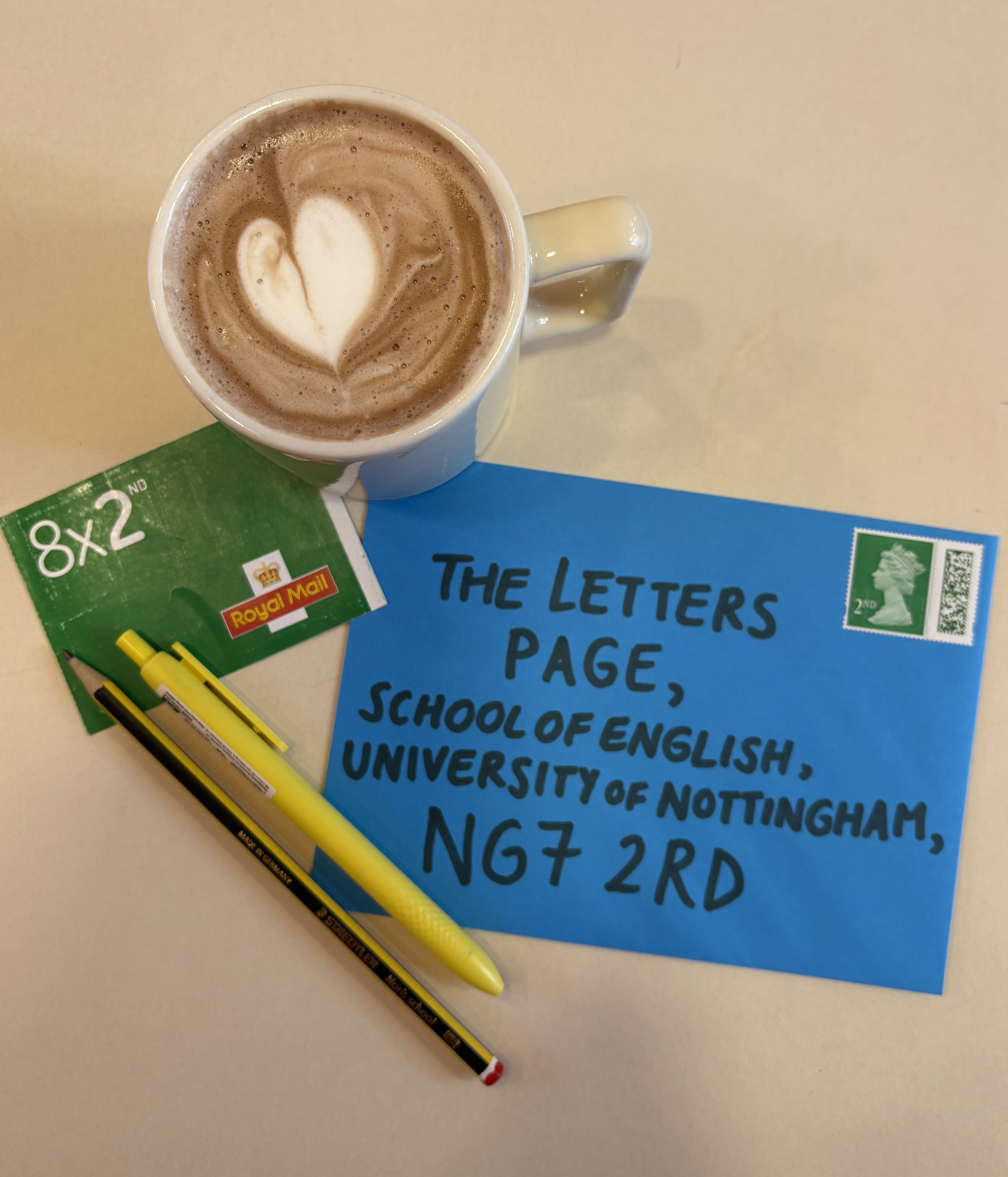
Photo credit: Zoe Lidbury
Zoe: I’ve never enjoyed having to face the painstaking ‘group project’. From experience, they tended to fail in one of two predictable ways: either I’d end up carrying the workload for classmates content to coast by on my (self-confessed) ‘nerdiness’, or I’d find myself locked in an exhausting struggle for creative control. It’s therefore unsurprising that my heart sank when I learned that my first task for The Letters Page would be to co-write an article with students I’d never met before. My reluctance towards collaboration isn’t unique. Academic research on the value of group projects frequently acknowledges students’ distaste for shared work.
Elodie: And to be fair, collaboration does come with its complications. As with any project, our team has had highs and lows. Sometimes one of us is absent. Sometimes we squabble over the best photo for the thumbnail of the article. We’ve also faced the hardest obstacle known to Gen Z: procrastination. Obsessing over one line or prospective titles rather than the word count has meant we constantly had to force each other to stay on task. However, these same moments – the overthinking, the deliberation – are also how we’ve curated our best and most well-thought-out lines.
Zoe: Much of my resistance stemmed from a desire to maintain creative control – a widely shared impulse. But I’ve come to see that instinct as a limitation. As Moya Sarner argues, ‘the ability to tolerate not being in control is essential to building a better life’ – and, as it turns out, to building a better article. Relinquishing sole authority meant engaging with new perspectives and thought processes. It required trust – not just in someone else’s ability, but in the process itself.
Elodie: Working in a team means being surrounded by ideas – and conveniently, walking thesauruses. It’s useful if the right word sits frustratingly out of reach on the tip of your tongue, or when the best photo requires four sets of hands. Editing between us is lovingly done and always with the reader in mind. This means it’s a lot easier to edit each other’s work without accidentally erasing the essence of what they were trying to say. The shared responsibility makes us more attentive. Every paragraph feels considered from more than one angle.
Within discomfort, collaboration proves its value. Through shared authorship comes new perspectives, stronger writing, and a great capacity for compromise.
Zoe: That attentiveness, however, does not remove the discomfort. Collaborative writing remains intimidating. Taking responsibility for other people’s work – suggesting edits, correcting phrasing, even removing a carefully crafted sentence – entails a huge amount of pressure and a significant emotional weight. The idea of proposing that someone else’s work could be improved is daunting. And yet it is precisely within this discomfort that collaboration proves its value. Through shared authorship comes new perspectives, stronger writing, and a greater capacity for compromise.
Elodie: In fact, the majority of the challenges we’ve tackled have also been our strengths. When faced with the daunting task of merging our individual writing styles together, we’ve managed to do this carefully and respectfully so all our voices can still be heard. In fact, this amalgamation (in our humble opinions) makes the articles more interesting to read. What emerges is something none of us could’ve produced alone: writing shaped by a variety of instincts and refined by multiple perspectives.
Zoe: Perhaps that is the quiet reward of collaboration. Not simply a stronger article, but a broader way of thinking – and, if you’re particularly lucky…
Elodie: And perhaps a little cheesy…
Zoe: Even a few new friends.
Interested in writing something yourself (or in collaboration)? The Letters Page team are back in the office, and ready to read your real letters again. We publish stories, essays, poems, memoir, reportage, criticism, recipes, travelogues, and any hybrid forms, so long as they come to us in the form of a letter. We are looking for writers of all nationalities and ages, both established and emerging.
Your letter must be sent in the post, to:
The Letters Page, School of English, University of Nottingham, NG7 2RD, UK
See our submissions page for more information.
Need some inspiration in your letter-writing endeavours? You can purchase our latest collection, The Letters Page, Vol. 5, by clicking here.
 theletters.page